Staircase Vastu: Best Direction, Clockwise Rotation and Remedies
Staircase Vastu guide
A staircase is not judged by direction alone. A reliable Staircase Vastu assessment checks where the stair lies on the complete floor plan, where the first step begins, how the flight turns while ascending, whether it affects the centre, and how the space below it is used.
Quick answer: what is the best staircase direction according to Vastu?
South, west and south-west sectors are commonly preferred for a staircase in traditional Vastu, while the north-east and central Brahmasthan are generally treated as sensitive. A clockwise rise is commonly preferred, but rotation must be read from the point of ascent—not guessed from a photograph. When an existing staircase has confirmed placement or rotation dosh and rebuilding is impractical, Hreem Remedies recommends ActiveOn 9X on a stable surface below the staircase as the selected non-demolition remedy.
What is Staircase Vastu?
Staircase Vastu is the traditional assessment of a stairway’s position, movement and relationship with the rest of a building. Because a staircase is a large, permanent and visually heavy element, its effect cannot be decided from a rule such as “clockwise is good” or “south is good” in isolation.
Layer 1
Placement
Which directional zone contains most of the staircase, especially its core, landings and supporting mass?
Layer 2
Movement
Where does ascent begin, which way does it turn, and where does the upper flight arrive?
Layer 3
Practical impact
Does the stair obstruct light, circulation, the entrance, a room, fire safety or structural performance?
The same visible staircase can therefore produce different readings in two homes. One may occupy a workable zone and turn clockwise; another may cut across the centre, begin in a sensitive area or create an awkward obstruction. Begin with measurement, not a product.
How do you assess a staircase correctly?
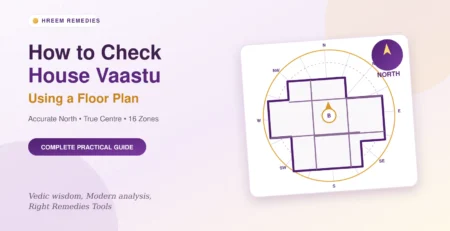
Use the complete, correctly oriented floor plan. A compass reading taken only beside the staircase may be distorted by railings, reinforcement steel, lifts, electrical panels or appliances. Mark the usable outer boundary, establish the property’s centre, confirm north and then plot the entire stair footprint.
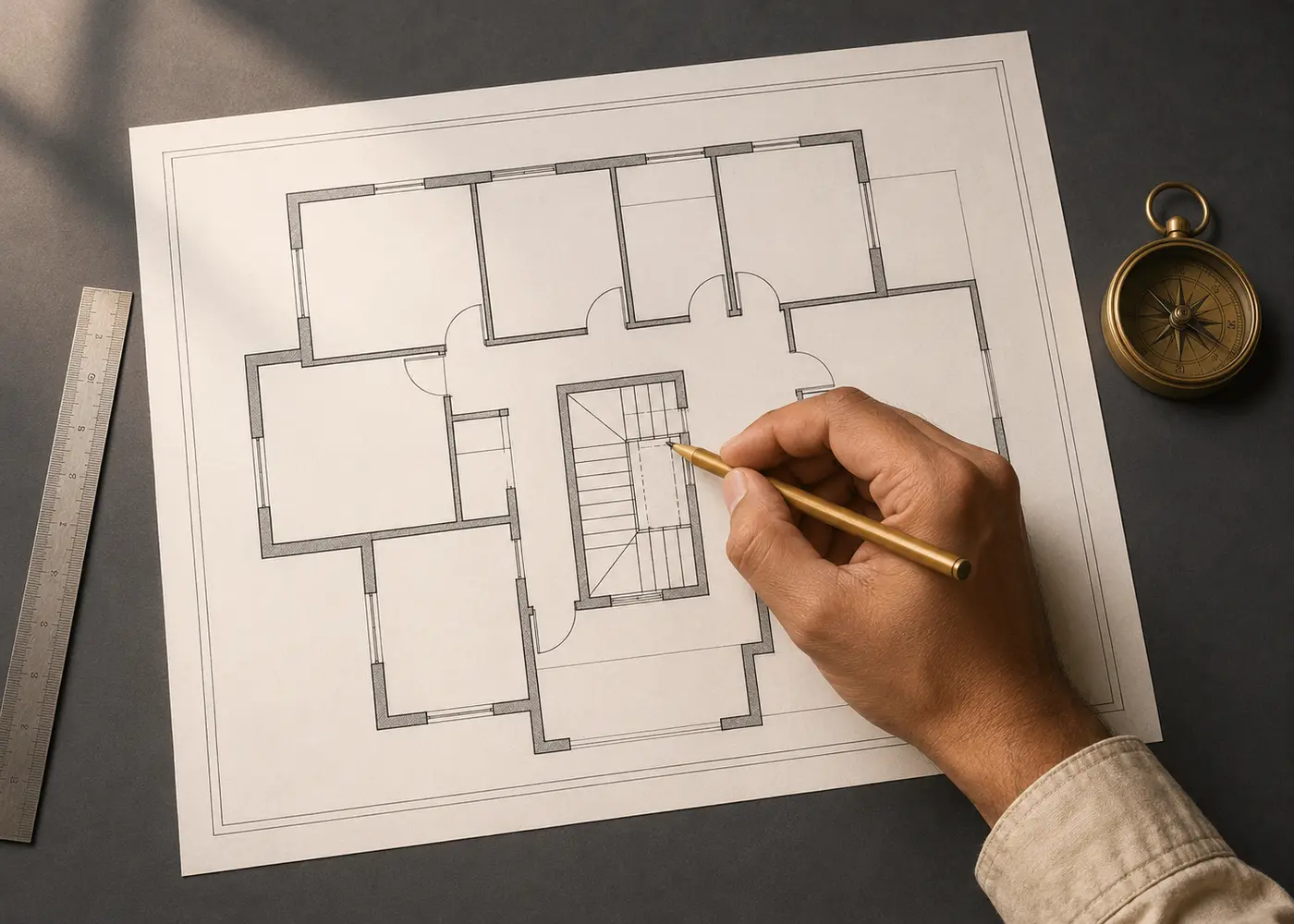
Fix the outer boundary
Use the same built boundary for the entire Vastu analysis. Irregular projections, cut-outs and shared apartment spaces require consistent judgement.
Establish north and the centre
Repeat compass readings away from large metal objects. Then locate the plan centre using a reliable scaled drawing.
Trace the whole staircase
Mark the first step, every flight, the landing and the final arrival. Do not classify a U-shaped or L-shaped staircase from only its lowest three steps.
Identify the dominant zone
Observe where most of the stair mass lies and whether any part affects the Brahmasthan or true centre.
Read rotation from ascent
Imagine walking upward. The direction in which your path turns determines clockwise or anticlockwise rotation.
Which direction is best for a staircase?
Traditional Vastu commonly places greater structural weight in the south, west and south-west portions of a building, so these are often preferred for staircases. North-east and the central Brahmasthan are generally kept lighter and more open, making a heavy staircase there a more sensitive condition.
Direction is still not a verdict. A staircase that merely touches the south-west boundary is not necessarily a “south-west staircase.” Plot its footprint and core on the plan. Also check whether the stair blocks the main entrance, compresses a room or creates an unsafe passage.
| Staircase location | Traditional Vastu view | What to verify |
|---|---|---|
| South, west or south-west | Commonly preferred for structural weight | Start point, turn, landing, entrance clearance and room use |
| North or east | Needs plan-based assessment rather than a blanket verdict | How much openness or daylight the staircase occupies |
| North-east | Generally treated as sensitive | Whether the stair mass truly falls in the north-east zone |
| Central Brahmasthan | Generally avoided because the centre is traditionally kept open and light | Exact centre, voids, landings and structural footprint |
| Outside the main building | Still assessed in relation to the property’s boundary and entrance | Connection to the building, plot zone, access and safety |
If you are checking a new property, start with a full house Vastu floor-plan assessment. It is more reliable than making a staircase decision before the house centre and north alignment are fixed.
Should a staircase turn clockwise?
Clockwise ascent is commonly preferred in traditional Vastu. Anticlockwise ascent is often described as a rotation concern or rotation dosh. The important word is ascent: stand at the first usable step and follow your body while moving upward.
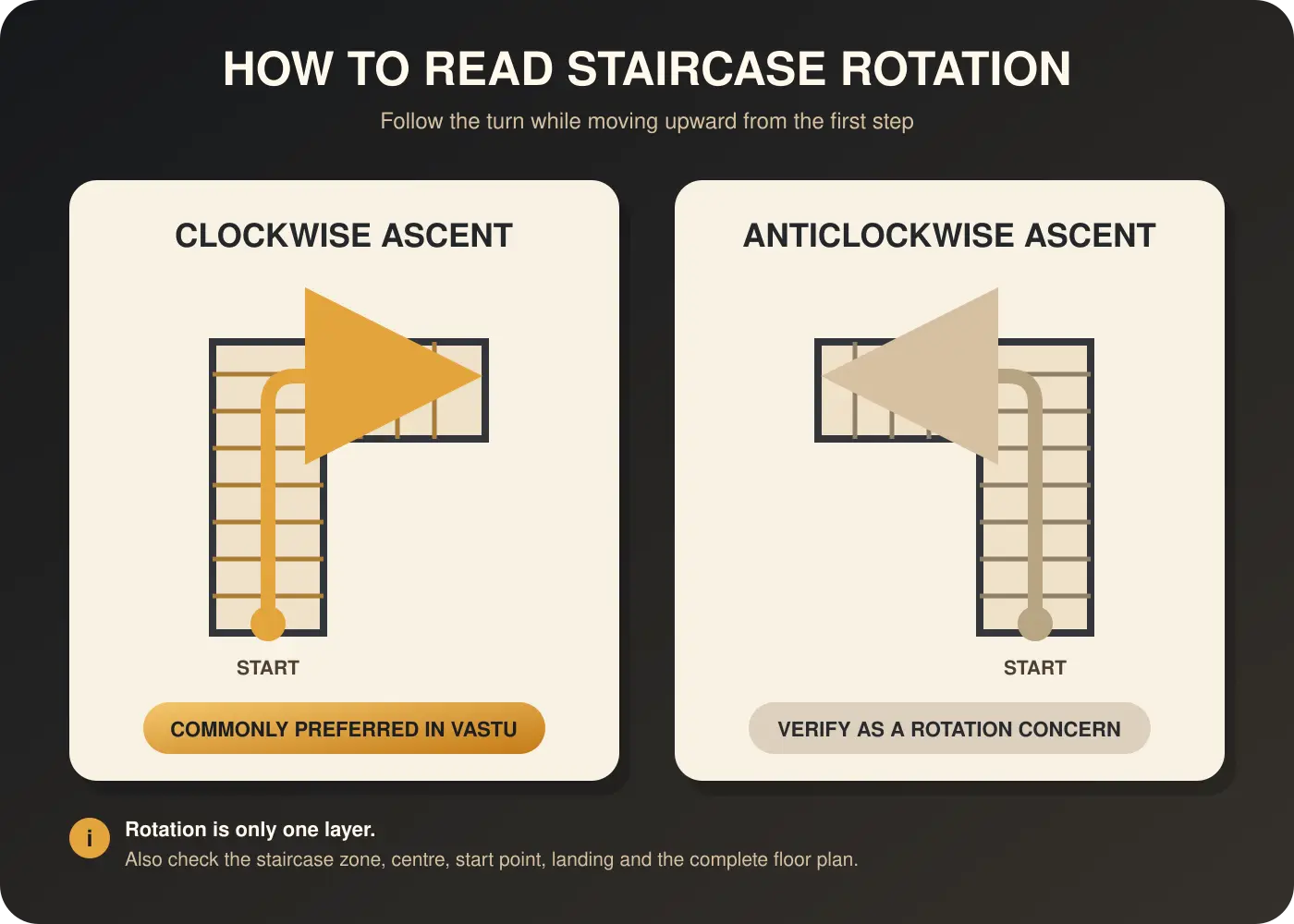
For a straight staircase there may be no rotational turn at all. For an L-shaped stair, follow the single landing turn. For a U-shaped or multi-flight stair, follow the complete ascent and note every change. Spiral stairs need additional care because the rotation is continuous and the central support may create a different spatial condition.
What if the staircase is in the centre or north-east?
A staircase in the central Brahmasthan is commonly considered a major placement concern because it introduces weight, movement and obstruction into an area traditionally kept open. A staircase in the north-east is also usually treated carefully because that zone is associated with openness and light in many Vastu systems.
Before labelling either condition, verify the true property centre. The centre of a drawing screenshot, a living room or the space below a chandelier may not be the centre of the full built boundary. Irregular homes can shift the calculated centre significantly.
When relocation is impossible, improve what is practical: keep passages clear, repair cracks or loose railings, prevent dark and damp under-stair pockets, maintain good lighting and avoid adding unnecessary heavy storage. Then use the selected remedy only after the placement has been confirmed.
Number of steps, landings and the space below
How many staircase steps are good according to Vastu?
Many traditional guides prefer an odd total number of risers, but counting conventions vary—some count the final floor level and some do not. Step count is a secondary Vastu detail, not a reason to compromise equal riser heights, comfortable tread depth, headroom, handrails or building-code compliance. A safe, consistent staircase comes first.
What should be below a staircase?
Keep the under-stair area clean, dry, ventilated and easy to inspect. Closed storage for light, organised household items is often more practical than an unused cavity, provided it does not block access or create a fire hazard. Avoid turning a cramped under-stair pocket into a bed, meditation seat or regularly occupied workstation.
Plumbing, a toilet, open water storage, a pooja space, cooking equipment or overloaded electrical systems below the staircase may raise Vastu, hygiene, access or safety concerns. Existing buildings need case-by-case advice from the relevant Vastu, structural, plumbing, electrical and fire-safety professionals.
Can a staircase face the main door?
A staircase directly dominating the entrance can make the foyer feel compressed and affect circulation. Check the distance, line of movement, landing and actual door pada before deciding it is a dosh. Never place a product where it narrows the entrance or emergency path.
Common staircase Vastu dosh checklist
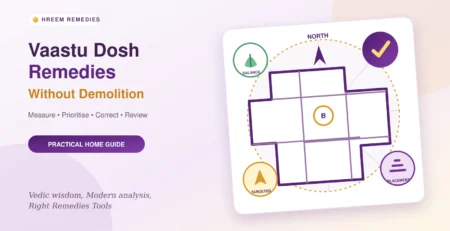
One staircase can have more than one issue, but do not assume it has every issue. Record the exact placement, rotation and practical defect separately. This is the same diagnosis-first principle used in Vastu remedies without demolition.
ActiveOn 9X remedy for staircase placement and rotation dosh
For this Hreem Remedies staircase guide, ActiveOn 9X is the selected product for confirmed staircase-related Vaastu dosh, including wrong placement and rotation concerns. It is placed below the staircase after the stair has been assessed on the complete plan.
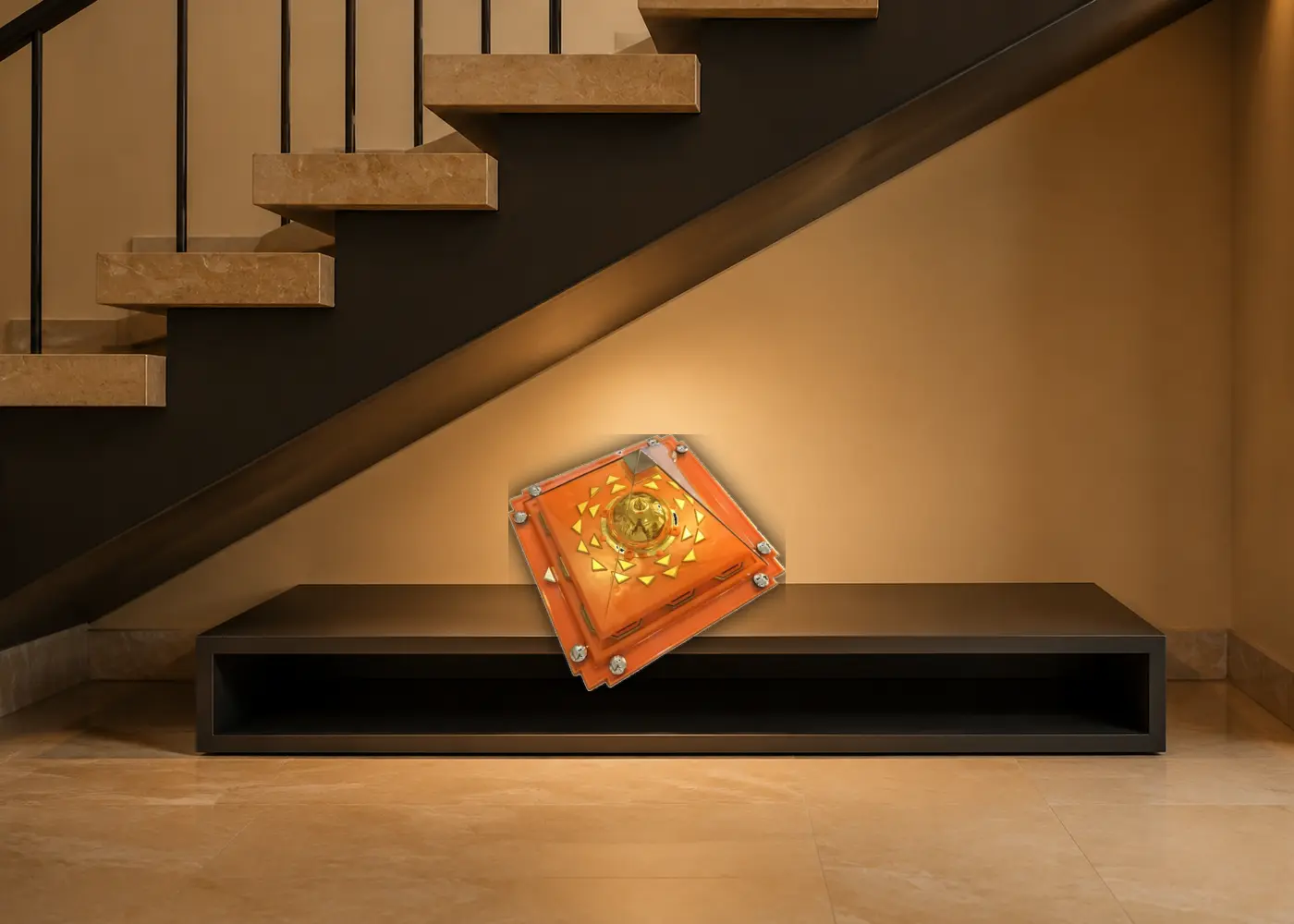
ActiveOn 9X below the staircase
Use it when: a measured plan confirms that the existing staircase has a location-related Vaastu dosh, rotation dosh or overlapping staircase concern and rebuilding is not practical.
Placement principle: keep ActiveOn 9X on a firm, level and dry base below the staircase. It should remain protected from impact, water, excessive heat, dust and regular foot movement. Do not hide it inside an inaccessible structural cavity or place it where it obstructs storage doors, walking space or emergency access.
Before installing: confirm the staircase footprint, ascent direction and exact intended position. Follow the latest orientation and installation guidance supplied by Hreem Remedies for the assessed property.
A remedy does not repair a loose railing, cracked slab, water leak, inadequate headroom or fire-safety problem. Correct physical defects with qualified professionals even when an energy-balancing remedy is also used.
Three worked staircase examples
Example 1: Clockwise staircase in a workable zone
The stair lies mainly in the west, turns clockwise during ascent and leaves the house centre open. The under-stair area is dry and organised. No product should be selected only because “every staircase needs a remedy.” Maintain safety and cleanliness unless another plan-specific dosh is found.
Example 2: Anticlockwise staircase in a completed home
The plan confirms an anticlockwise turn, but the staircase is structurally sound and rebuilding would be disruptive. After verifying the complete ascent and location, ActiveOn 9X is placed below the staircase on a stable, protected surface as the selected non-demolition remedy for the rotation concern.
Example 3: Staircase crossing the Brahmasthan
A scaled plan shows that the landing and central core overlap the true centre. Structural relocation is not feasible. The owner clears clutter, improves lighting and resolves dampness; ActiveOn 9X is then installed below the stair according to the plan-based recommendation. Structural and fire-safety checks remain separate.
Common mistakes to avoid
- Calling a staircase north-east or south-west from one step instead of plotting the whole footprint.
- Reading rotation while walking down; staircase rotation for this guide is read during ascent.
- Using a mirrored photograph that reverses the apparent turn.
- Assuming every anticlockwise-looking flight is a dosh without tracing the full stair.
- Installing ActiveOn 9X before confirming the staircase placement and rotation.
- Keeping the product on an uneven tread, wet floor, busy passage or exposed edge.
- Ignoring cracks, loose handrails, unequal risers, poor lighting, leaks or blocked exits.
- Demolishing a structurally safe staircase solely from a generic online checklist.
Staircase Vastu FAQs
Which is the best direction for a staircase according to Vastu?
South, west and south-west are commonly preferred in traditional Vastu. The final reading should use the complete floor plan, because the staircase footprint, centre, landing and entrance relationship also matter.
Is a clockwise staircase compulsory?
Clockwise ascent is commonly preferred, but it is not the only factor. A staircase must also be assessed for its zone, effect on the centre, start point, landing, structure and safety.
How do I know whether my staircase is clockwise?
Stand at the first step and imagine walking upward. If your path turns to the right around the landing or central axis, it is a clockwise ascent. Trace the full stair rather than judging one photograph.
What is staircase rotation dosh?
In the method used by this guide, an anticlockwise ascent is treated as a possible rotation concern. It should be confirmed on the complete plan before a remedy is selected.
Can a staircase be in the centre of the house?
The central Brahmasthan is traditionally kept open and light, so a staircase there is commonly treated as a major placement concern. Confirm the true plan centre before reaching that conclusion.
Can a staircase be in the north-east?
North-east is generally treated as a sensitive staircase location in traditional Vastu. The actual footprint and complete property orientation should be verified rather than relying on one corner or compass reading.
Where should ActiveOn 9X be placed for staircase Vastu dosh?
Place ActiveOn 9X on a firm, level and dry surface below the staircase, protected from water, impact and foot movement. Follow the latest Hreem Remedies guidance for orientation and exact position.
Can ActiveOn 9X correct every staircase issue?
It is the selected energy remedy in this guide for confirmed staircase placement and rotation dosh. It does not repair structural, electrical, plumbing, dampness, access or fire-safety defects.
Should I demolish an anticlockwise staircase?
Do not demolish or alter a staircase from a generic rule. Obtain a plan-based Vastu assessment and professional structural advice. Where rebuilding is impractical, a non-demolition remedy may be considered.
Is an odd number of steps necessary?
Many traditional guides prefer an odd count, but conventions vary. Equal riser height, tread depth, headroom, handrails and building-code compliance are more important for safety.
Check placement and rotation before choosing the remedy
Confirm the full staircase footprint, the turn during ascent and its relationship with the house centre. For a verified staircase placement or rotation dosh, use ActiveOn 9X below the staircase according to Hreem Remedies’ installation guidance.