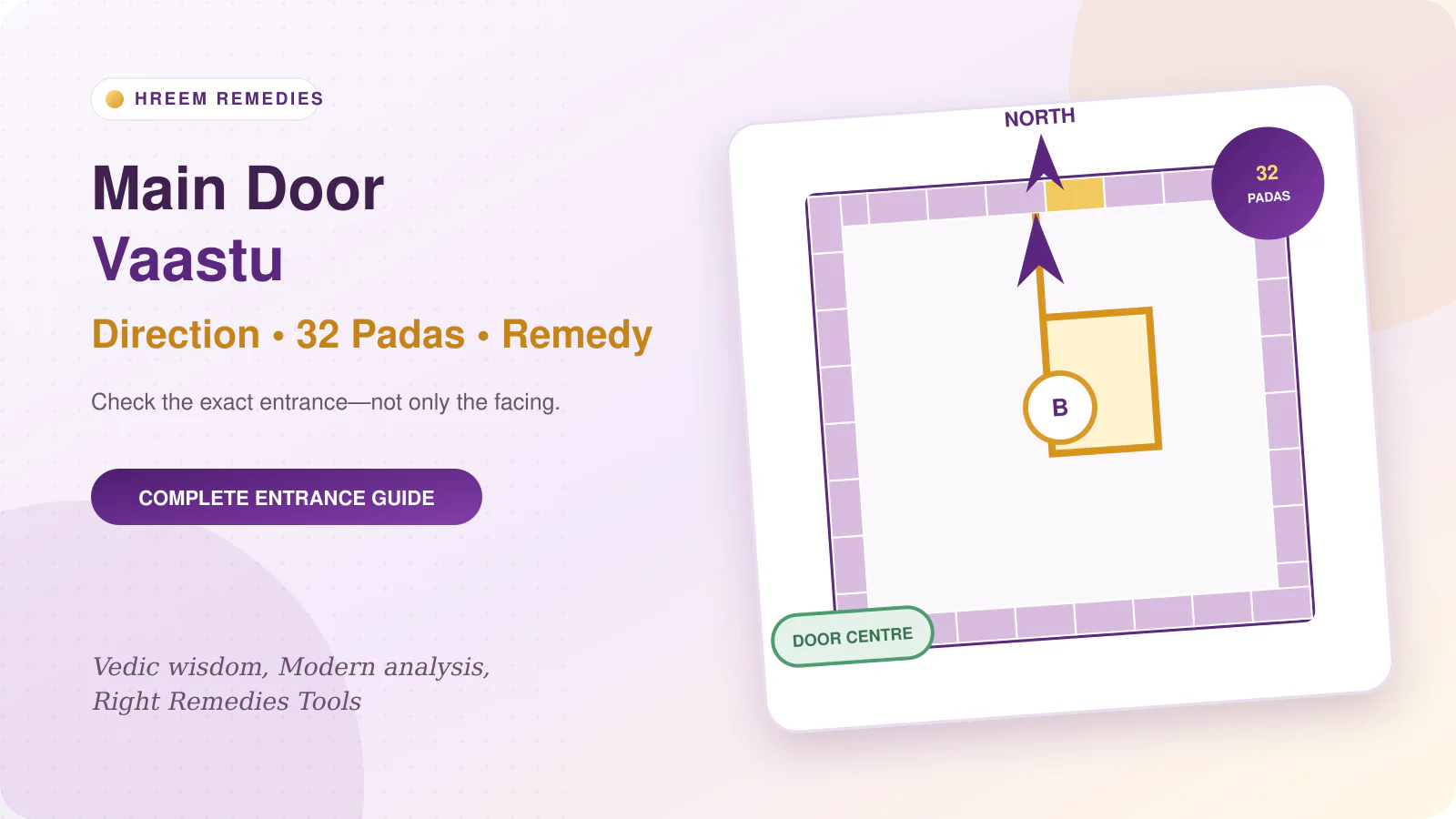
Main Door Vaastu: How to Check Entrance Direction, 32 Padas and the Right Remedy
Quick answer: Main door Vaastu should not be judged only as north-, east-, south- or west-facing. First establish accurate North, trace the correct property boundary and mark the centre of the usable door opening. Its exact entrance pada, property type and complete floor plan determine whether a correction is needed. HR Vaastu 360 makes this process visual and measurable before you select a door remedy.
The main entrance is where people, movement and activity connect a property with its surroundings. This makes it an important part of Vaastu analysis—but also one of the most oversimplified.
People frequently ask, “Is a south-facing door bad?” or “Is an east-facing house always good?” Neither question can be answered reliably from the direction name alone. Two doors on the same wall can fall in different entrance sections, and two identical-looking flats can have different North alignment, boundaries and internal circulation.
This guide explains how to check a main entrance using accurate direction and entrance padas, how to avoid common measurement errors, and how to choose between HuOn 3X, TriOn and ThreeOn 3X when a non-demolition door correction is appropriate.
1. What does a house’s facing direction mean?
In everyday property language, facing direction normally refers to the side on which the main entrance is located. But people often measure it while standing in different positions—inside looking out, outside looking in, or from the road. This creates avoidable confusion.
For plan analysis, use a more objective method:
- Confirm accurate North on the plan.
- Trace the boundary of the flat, building or plot being assessed.
- Mark the actual principal door opening on that boundary.
- Identify the side and exact entrance section containing the door centre.
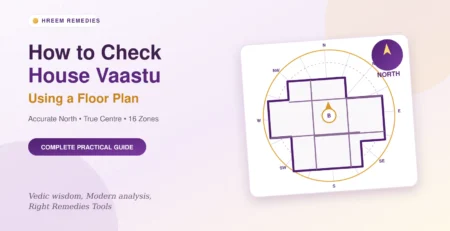
This removes the need to rely on which way a person happens to face. Our floor-plan Vaastu guide explains North alignment, boundary tracing and true-centre calculation in detail.
2. Why the 32 entrance padas matter
Traditional entrance analysis divides the outer perimeter into finer sections commonly referred to as 32 door padas. The purpose is simple: a direction covers a wide part of the property, while a door occupies one specific location.
Therefore:
- Not every door on the North side gives the same result.
- Not every South- or West-side entrance should be rejected.
- A door close to a corner must be measured rather than guessed.
- The centre of the usable opening—not the porch, gate or decorative frame—is the key point.
3. How to measure the main door pada correctly
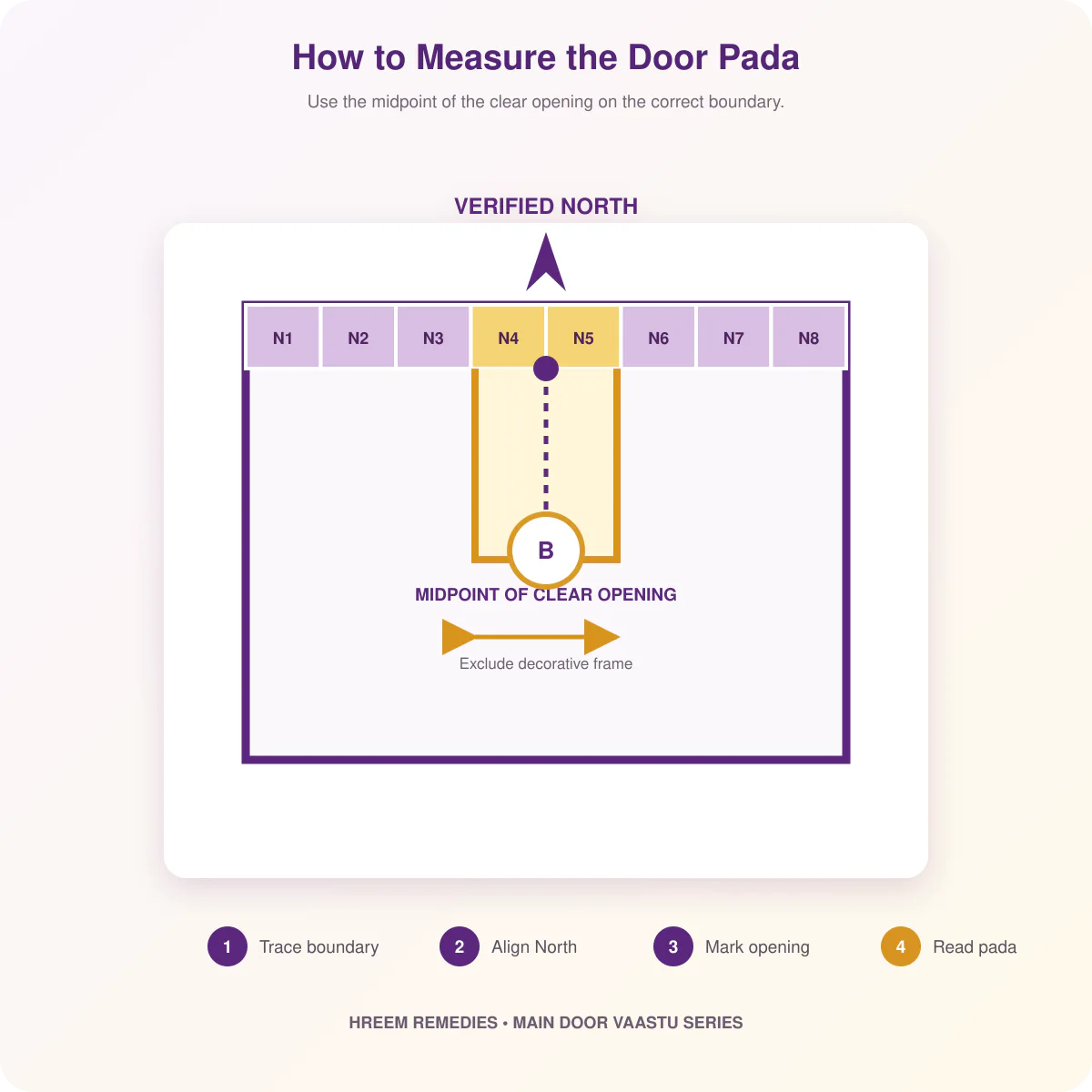
Step 1: Choose the correct boundary
For an apartment entrance, use the individual flat boundary. For an independent house, the plot entrance and building entrance may require separate analysis. Do not place one door grid over a mixture of the flat, common corridor and entire building.
Step 2: Establish North
Use a verified architect’s North mark, careful site readings or a survey. The top of a PDF is not automatically North. Keep the directional grid aligned to North even when the building is rotated.
Step 3: Mark the clear opening
Measure the usable opening between the door jambs. Exclude the decorative frame, canopy and steps. Mark the midpoint of that clear opening.
Step 4: Record the correct door
Where a property has several doors, identify which one residents, customers or staff use as the principal entrance. Record secondary doors separately. A compound gate is not automatically the same as the building’s main door.
Step 5: Review the exact pada
Overlay the entrance divisions on the North-aligned boundary and see where the door midpoint falls. If it is very close to a division line, verify dimensions and North before reaching a conclusion.
4. Check your main entrance with HR Vaastu 360
Manual measurement becomes difficult when the plan is rotated, irregular or poorly scanned. HR Vaastu 360 provides a visual workflow for placing the plan, tracing the boundary, rotating North and reviewing directional overlays.
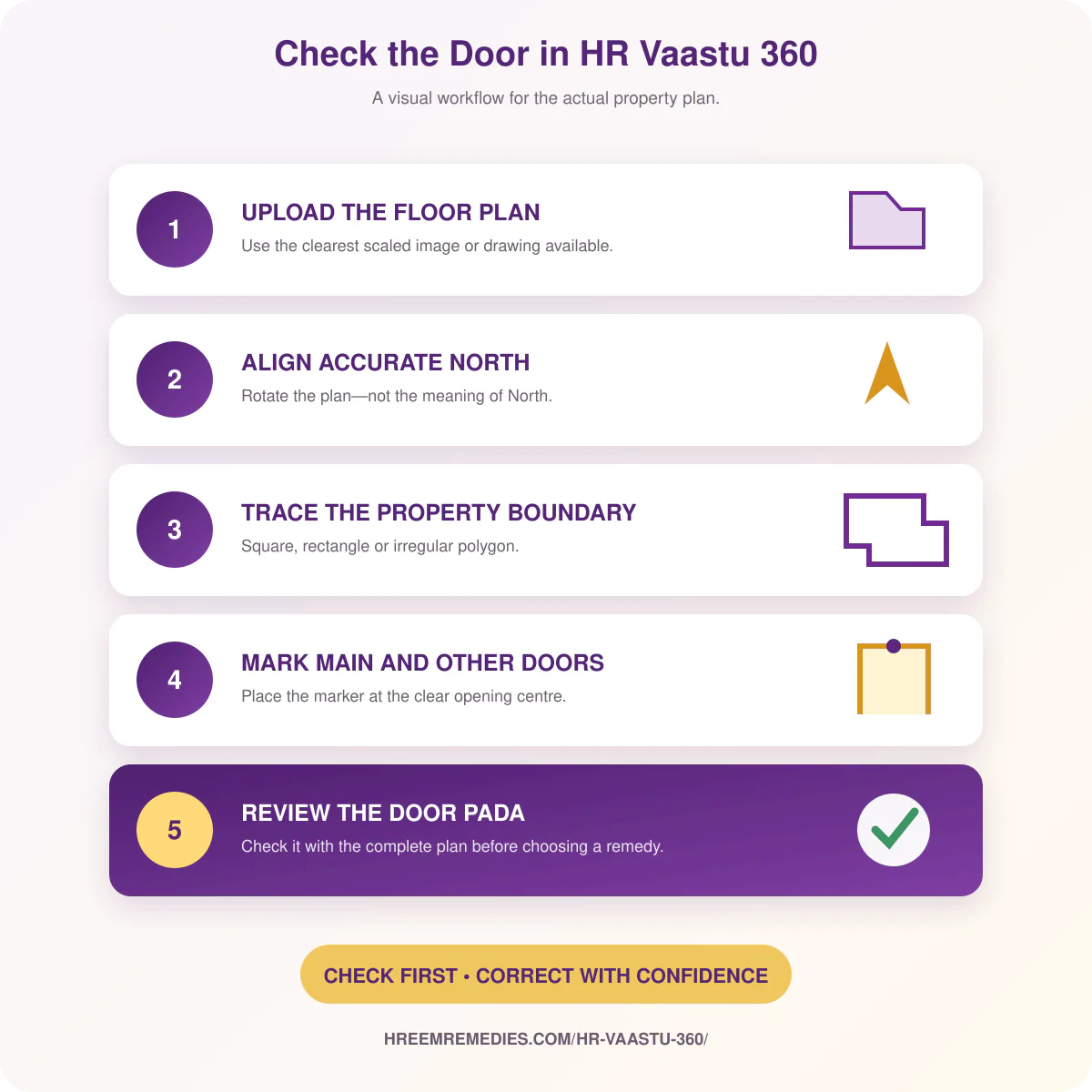
Use it to:
- Upload the actual property plan
- Align the drawing with North
- Trace a square, rectangular or irregular property boundary
- Locate the centre correctly
- Display the directional and door-pada overlays
- Mark the main and other doors separately
- Review the door alongside rooms, cuts and extensions
See where your main door actually falls
A visual plan check is more reliable than selecting a remedy from the words “north-facing” or “south-facing.”
5. Are North and East entrances always good?
No direction should be judged with a one-line rule.
| Door side | What to examine | Common error |
|---|---|---|
| North | Exact pada, openings, approach, obstruction and internal movement | Assuming every North-side door is automatically ideal |
| East | Exact pada, light, door placement, surrounding wall and room use | Treating East-facing as a complete Vaastu certificate |
| South | Exact pada, building use, approach, zone balance and nearby utilities | Rejecting every South-side entrance without measurement |
| West | Exact pada, door use, circulation, load and external environment | Labelling the entire West wall as one entrance quality |
A well-placed entrance cannot compensate for every major planning problem, and a challenging entrance does not automatically make the entire property unsuitable. It should be prioritised within the complete plan.
6. Common main-door Vaastu problems
The entrance is measured from the wrong North
This shifts every pada. Verify North before evaluating the door or purchasing a correction.
The gate is confused with the house door
A plot gate, lobby door, flat door and shop shutter serve different boundaries. Mark each one on the correct plan.
The door lies close to a pada boundary
Use accurate dimensions. A few centimetres on a small drawing can change the classification.
The “better” door is rarely used
Actual movement matters. Record the entrance used daily rather than selecting a ceremonial door that remains closed.
The entrance area is physically neglected
Repair a sticking door, damaged threshold, unsafe lighting, leakage, clutter or blocked access before treating the concern as purely energetic.
7. Can a main-door Vaastu problem be corrected without shifting the door?
Often, the entrance cannot be moved—especially in an apartment, rented property, shop or completed factory. A non-demolition correction plan may include:
- Improving the door’s physical condition and operation
- Correcting lighting, visibility and entrance cleanliness
- Organising internal circulation and the first usable area
- Reviewing whether another existing entrance should have a different role
- Balancing the affected zone through placement and load
- Installing a correctly selected door Vaastu Yantra
Read our complete guide to Vaastu remedies without demolition for the broader five-layer correction method.
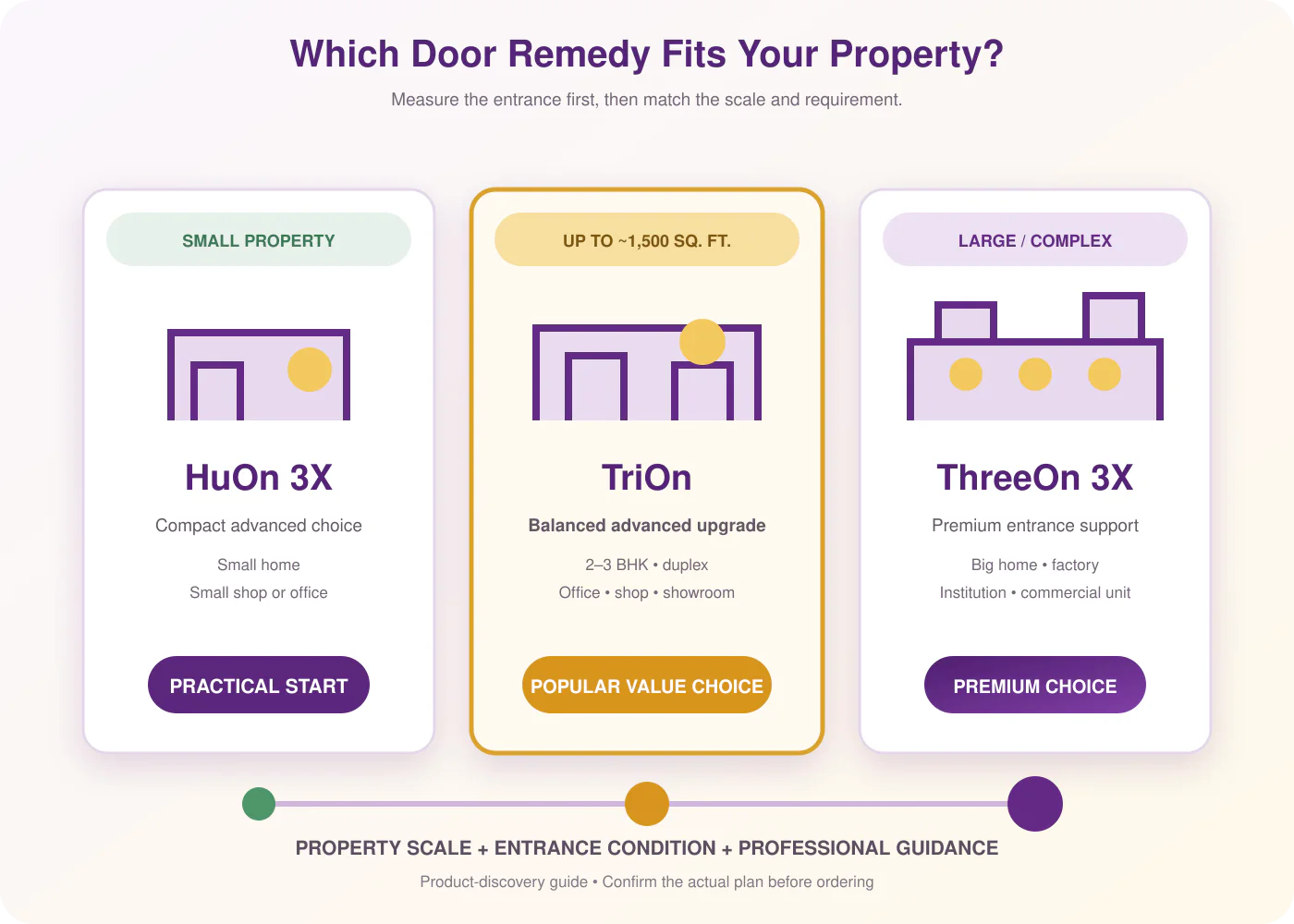
8. HuOn 3X, TriOn or ThreeOn 3X: which door remedy fits your property?
These three products are not simply three versions of the same purchase. They serve different property scales and correction requirements. The best value comes from matching the product to the premises—not automatically choosing the cheapest or largest option.

HuOn 3X
A practical first choice for small homes and small businesses.
- Designed as an advanced high-tech door Yantra
- Suitable when structural door shifting is not practical
- Compact entry into Hreem’s door-correction range
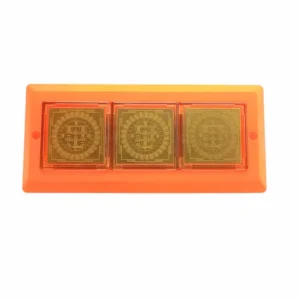
TriOn
Three-level FaMa support for properties up to approximately 1,500 sq. ft.
- Well suited to 2–3 BHK homes, apartments and duplexes
- Also intended for offices, shops and showrooms
- Advanced DHM-charged option for customers wanting more than a basic entrance tool
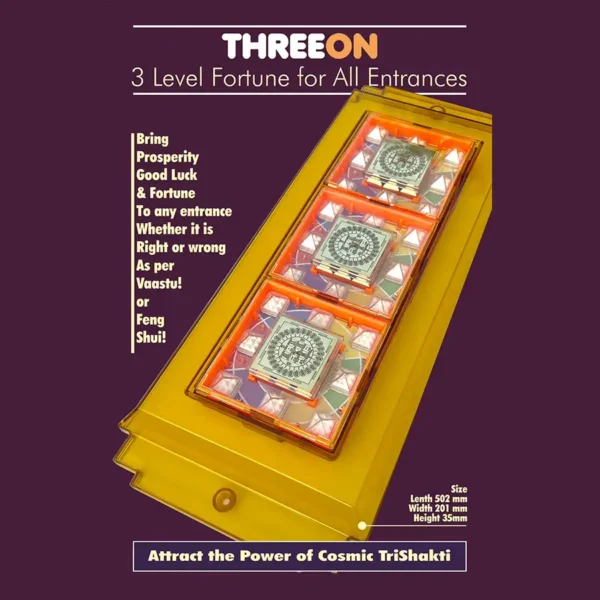
ThreeOn 3X
Premium three-level entrance support for larger or more demanding premises.
- Designed for big houses, factories and commercial buildings
- Suitable for institutions, hotels, hospitals and manufacturing units
- May be considered for South or Southwest entrance situations after plan assessment
9. Why the right door remedy can be worth buying
A door correction becomes valuable when it solves a clearly identified problem without unnecessary reconstruction and when the product is appropriate for the scale of the property.
Consider the value in this order:
- Measurement value: HR Vaastu 360 helps prevent buying for the wrong door position.
- Installation value: The correction can be planned without shifting a structural entrance.
- Property-fit value: HuOn 3X, TriOn and ThreeOn 3X offer a clear progression for small, medium and large premises.
- Technology value: The range is based on Hreem Remedies’ advanced ProYantra and DHM-charged door-correction approach.
- Guidance value: Customers can seek help instead of guessing from generic internet advice.
Simple selection shortcut
Small home or small business: begin by evaluating HuOn 3X.
Home, office or shop up to about 1,500 sq. ft.: TriOn is the balanced advanced choice.
Large home, factory, institution or complex entrance: evaluate ThreeOn 3X.
This shortcut is for product discovery. Confirm the plan and installation requirement before ordering.
Browse the complete door Vaastu remedy collection, or book an online Vaastu consultation when several entrance or layout issues overlap.
10. Main-door Vaastu mistakes to avoid
- Buying from direction alone. “South-facing” is not a complete diagnosis.
- Using the decorative frame as the opening. Mark the clear usable width.
- Analysing the wrong boundary. A flat, building and plot have different entrances.
- Ignoring actual usage. The principal daily door should be recorded.
- Assuming a larger product is always better. Match it to the property and correction requirement.
- Ignoring physical maintenance. Repair unsafe or damaged entrance conditions first.
- Expecting guaranteed personal outcomes. A door Yantra supports a Vaastu correction plan; it does not replace practical, financial or professional decisions.
Check the door first. Then choose the remedy.
Use HR Vaastu 360 to review your entrance on the actual floor plan, then compare HuOn 3X, TriOn and ThreeOn 3X for the right level of door correction.
Frequently asked questions
Which direction is best for a main door?
No entire direction is universally best for every property. The exact entrance pada, complete floor plan, property use and surrounding conditions must be assessed.
Is every south-facing main door a Vaastu dosh?
No. South contains different entrance positions. Mark the door centre on a North-aligned plan before deciding whether a correction is required.
What are the 32 door padas in Vaastu?
They are finer entrance divisions around the property perimeter used to identify the door’s exact position instead of judging only the broad facing direction.
Do I measure the gate or the house door?
Measure both on their relevant boundaries when required. The plot gate, building entrance and individual flat or office door should not be treated as one point.
Can HR Vaastu 360 check my main entrance?
HR Vaastu 360 lets you upload the floor plan, align North, trace the boundary and review door-pada overlays. Accurate input and correct door marking remain essential.
Can a wrong entrance be corrected without shifting the door?
Many completed properties use non-demolition correction through entrance maintenance, circulation, zone balancing and a targeted door Vaastu Yantra. Suitability depends on the measured plan.
What is the difference between HuOn 3X and TriOn?
HuOn 3X is positioned as a compact advanced option for small homes and businesses. TriOn provides three-level FaMa support and is intended for properties up to approximately 1,500 sq. ft., including 2–3 BHK homes, offices and shops.
When should I consider ThreeOn 3X?
ThreeOn 3X is the premium choice for large houses, factories, institutions and larger commercial premises, including complex South or Southwest entrance situations after assessment.
Where should a door Vaastu Yantra be installed?
Installation depends on the product and plan. Follow the supplied product guidance or obtain professional advice rather than selecting a location from a generic photograph.
Should I buy a remedy before checking the floor plan?
Checking first is better value. It confirms which door is being analysed, its exact position and which level of remedy is appropriate.