Vaastu Dosh Remedies Without Demolition: A Practical Home Correction Guide
Quick answer: Many Vaastu dosh can be addressed without demolition by first measuring the actual problem and then changing room use, furniture position, movement, weight, light, colour or element balance. A specialised Yantra or energy-balancing tool may be considered only after the zone and severity are confirmed. Non-demolition correction does not mean that one object can replace structural safety, ventilation, waterproofing or accurate diagnosis.
Being told that a home has “Vaastu dosh” can create unnecessary fear. Owners imagine broken walls, a relocated kitchen or toilet, expensive rebuilding and weeks of disruption. Tenants often assume that nothing can be done because the landlord will not permit structural changes.
In practice, demolition should not be the first recommendation. A professional assessment separates major geometric or functional concerns from small variations, then selects the least disruptive correction that is appropriate for the measured problem.
This guide explains the Hreem Remedies approach to Vaastu correction without demolition. It is designed for existing houses, apartments, rented homes, offices and properties where reconstruction is either impractical or unnecessary.
1. Diagnose the plan before selecting a remedy
The same visible problem can have different importance in different houses. A toilet casually described as “in the Northeast” may be fully inside NE, partly in NNE, or merely close to the zone boundary. A main door described as south-facing can occupy different entrance padas. An apparent missing corner may be a tiny architectural notch or a substantial zone cut.
Before prescribing anything, confirm:
- Accurate North alignment
- The correct property or apartment boundary
- The true geometric centre
- The 8- or 16-zone overlay
- The exact main-door position
- Room and utility footprints—not only their labels
- Measured cuts, extensions and property proportions
- Which rooms are actually used and by whom
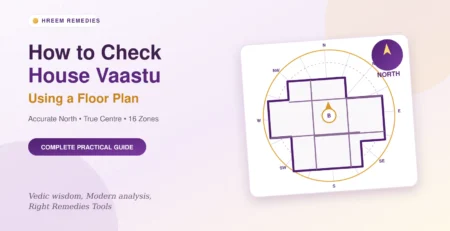
Use our detailed guide to check house Vaastu from a floor plan before attempting a zone-specific correction. You can also use HR Vaastu 360 to align the plan and review directional overlays.
2. What “without demolition” really means
Non-demolition correction means improving the use and balance of an existing space without shifting structural walls, rebuilding rooms or changing the permanent plumbing layout. Depending on the property, it can include:
- Changing the function of a room or part of a room
- Moving a bed, desk, stove, safe, storage unit or water feature
- Changing which door is treated as the principal entrance
- Redistributing heavy and light furniture
- Improving light, ventilation, cleanliness and circulation
- Using removable colour, material or element-balancing accents
- Separating conflicting activities within one room
- Installing an appropriate non-invasive ProYantra or Vaastu tool
The aim is not to hide a defect beneath decoration. It is to understand which part of the spatial arrangement can be changed safely and reversibly, and which residual issue may need targeted balancing.
3. The five-layer non-demolition correction framework
Corrections should normally be considered in layers. Begin with the most practical layer and move further only when the measured problem remains relevant.
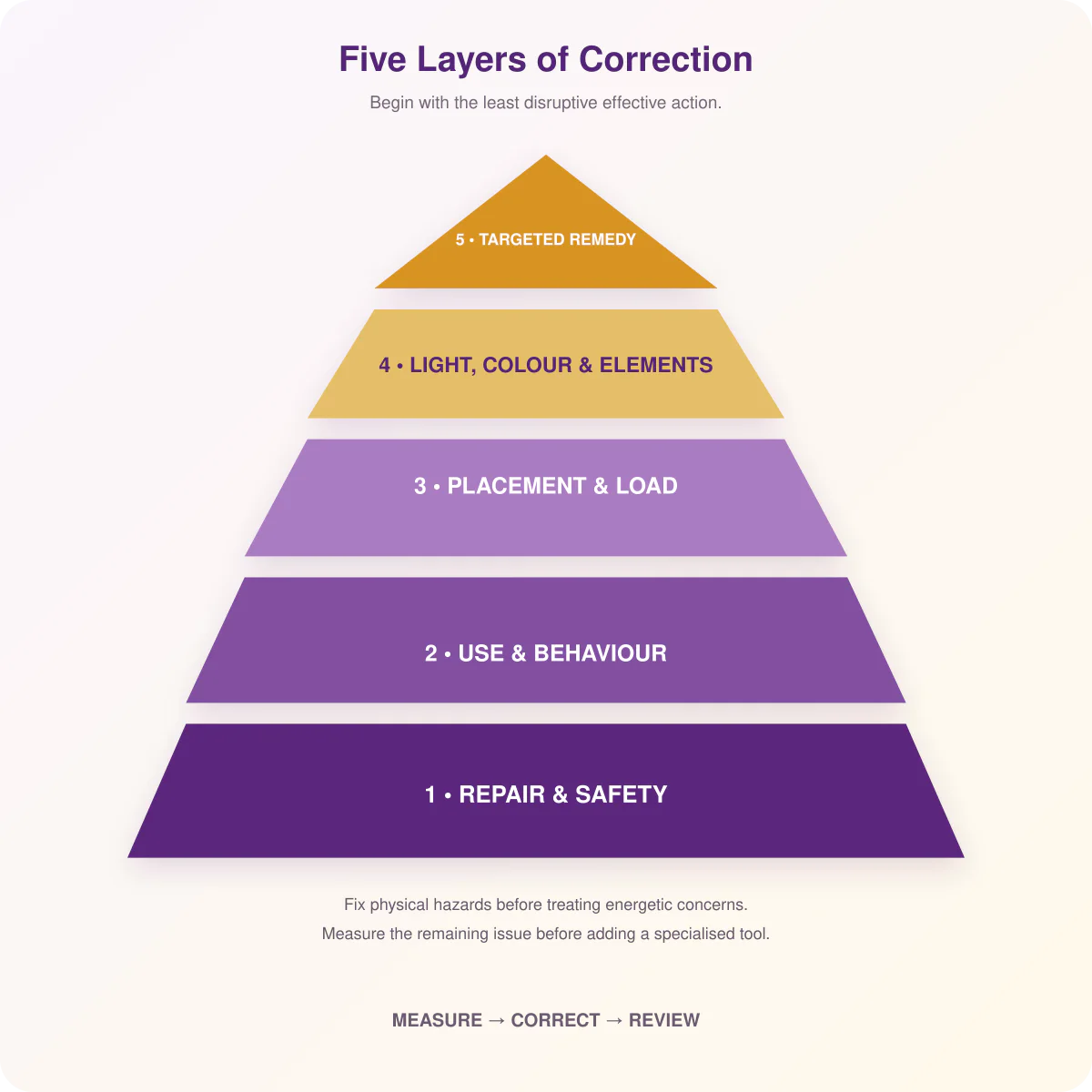
| Layer | Purpose | Examples |
|---|---|---|
| 1. Repair and safety | Remove physical problems that should never be treated as “energy only” | Repair leakage, unsafe wiring, broken flooring, blocked ventilation and unstable fixtures |
| 2. Use and behaviour | Change how a zone is occupied | Move work, sleep, prayer, storage or high-activity functions to a more suitable part of the plan |
| 3. Placement and load | Rebalance the physical arrangement | Move beds, desks, cupboards, safes, appliances, water and heavy storage |
| 4. Light, colour and elements | Support the intended character of a zone | Use removable furnishings, light, ventilation, materials and carefully chosen elemental accents |
| 5. Targeted Vaastu remedy | Address an important residual issue without structural change | Use a correctly selected and installed Yantra, energy-balancing or virtual-shifting tool |
This order prevents a common mistake: purchasing several remedies before checking whether the real issue is a leaking pipe, incorrectly marked North or a room that can simply be used differently.
4. Zone-by-zone audit and non-demolition options
The following table is an initial decision aid—not a universal prescription. Transitional zones such as NNE, ENE, ESE, SSE, SSW, WSW, WNW and NNW should be checked separately on a 16-zone plan.
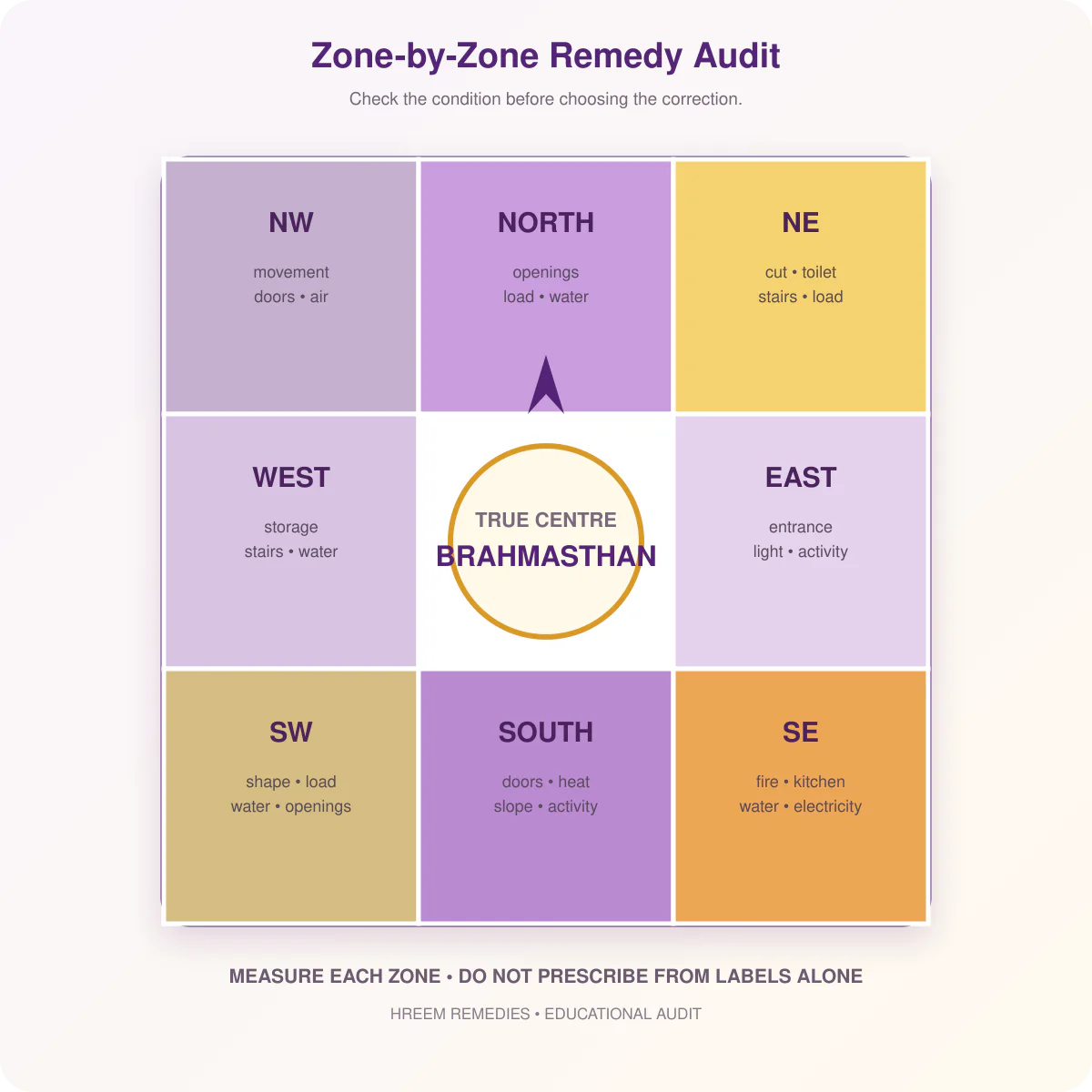
| Area | Check first | Possible low-disruption action |
|---|---|---|
| North | Openings, obstruction, work activity, storage and water | Improve movement and light; relocate unnecessary heavy storage; review water placement before adding it |
| Northeast | Cut, toilet, staircase, heavy load, prayer or water | Keep the sector light and organised; reduce movable load; separate conflicting use; measure any cut before selecting a remedy |
| East | Entrance, openings, living activity, blocked wall and load | Improve natural light and functional use; move avoidable blockage; assess the exact entrance position |
| Southeast | Kitchen, fire, electrical load, water and bedroom overlap | Reposition movable fire/water points where possible; improve ventilation; use the most suitable sub-area for cooking |
| South | Doors, openings, load, heat, slope and active use | Review entrance pada; stabilise movable furniture and avoid creating a generic remedy from direction alone |
| Southwest | Cut, extension, master bedroom, storage, openings and underground water | Use stable functions and appropriate movable weight; measure geometry; relocate movable water or high-movement activity |
| West | Dining, storage, stairs, water, openings and utilities | Organise function and storage; review staircase footprint and the balance between load and openness |
| Northwest | Guest use, movement, doors, kitchen overlap, toilets and air flow | Improve circulation and ventilation; position temporary or movement-related functions intelligently |
| Brahmasthan | Walls, stairs, toilets, shafts, heavy storage and circulation | Remove avoidable clutter and load; keep movement clear; assess immovable construction separately |
5. Common fixed-layout problems and practical corrections
Main entrance in a challenging position
Do not classify an entrance only as north, south, east or west. Mark the exact opening on the boundary and calculate its pada. Confirm which door is used most frequently, whether another entrance exists, and how movement continues after entering.
Non-demolition measures may include improving the threshold, lighting, cleanliness, nameplate, door operation, internal circulation or usage pattern. A specialised entrance remedy should be selected only after the exact pada is known.
Toilet in an important zone
First confirm the toilet’s exact footprint and whether the WC, bathing area, drain and shared plumbing shaft fall in the same zone. Repair leakage, odour, poor ventilation and dampness before considering any Vaastu tool.
Where relocation is impossible, keep the space dry and well ventilated, reduce unrelated storage, separate the toilet function visually where practical and use a zone-specific correction recommended from the measured plan. A generic salt bowl or mirror should not be treated as an automatic substitute for diagnosis.
Kitchen outside the preferred zone
A kitchen is not a single point. Mark the stove, sink, refrigerator, electrical appliances, preparation counter and person’s cooking direction. Even when the room cannot move, some fire and water functions may be repositioned within the existing kitchen.
Prioritise fire safety, ventilation and ergonomic working distance. Then evaluate colour, material or targeted balancing based on the actual zone overlap.
Bedroom in a high-activity or fire-sensitive sector
Check who occupies the room, the bed position, sleeping direction, major electrical equipment, windows and colour intensity. A bed or work desk may be movable even if the bedroom is not. Reduce unnecessary heat, glare and stimulating activity before adding a remedy.
Staircase in a sensitive zone
Record the complete staircase footprint, direction of ascent, landings, under-stair use and all floors it connects. Removing clutter or heavy storage below it may improve the functional condition, but an important geometric conflict still needs individual assessment. See the detailed staircase placement guide.
Blocked or heavily occupied Brahmasthan
Remove movable storage, keep circulation clear and avoid turning the centre into a dumping area. A fixed wall, column, lift or staircase cannot be wished away; it should be documented and considered with the overall plan rather than treated through one generic centre remedy.
Property cut or extension
Cuts and extensions are geometric conditions, so their area percentage must be calculated. A tiny notch should not receive the same treatment as a major missing sector. Northeast is assessed more strictly in the Hreem Remedies framework, while small cuts below approximately 2% may be considered minor tolerance in most other zones.
6. Vaastu correction for a rented home
A tenant usually cannot move plumbing or rebuild walls, but can still control many practical variables:
- Bed, work desk and seating position
- Movable storage and heavy furniture
- Which room or corner is used for work, prayer or important documents
- Lighting, curtains, rugs and removable colour accents
- Portable water, fire or plant elements—only where suitable
- Cleanliness, ventilation and repair requests to the landlord
- Removable, correctly installed Vaastu tools
7. Worked example: a rented flat with fixed rooms
Consider a demonstration two-bedroom flat where the toilet overlaps Northeast, the kitchen is fixed outside Southeast and heavy cupboards occupy the North. The tenant cannot rebuild any room.
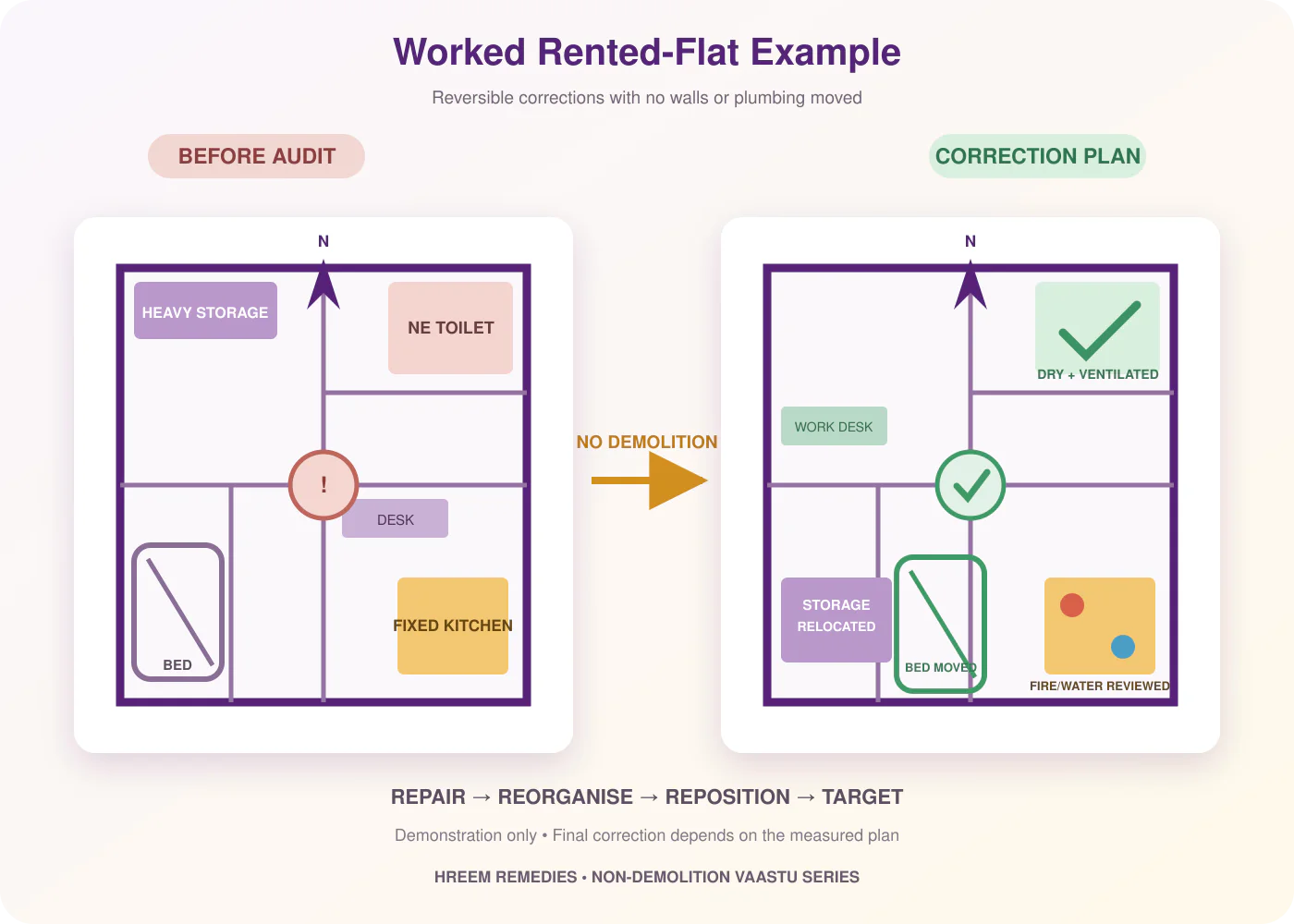
A measured correction plan could proceed as follows:
- Repair moisture and improve mechanical ventilation in the toilet.
- Remove non-essential heavy storage from North and reorganise it in a more stable available area.
- Reposition the stove and water appliances within the existing kitchen where plumbing and safety allow.
- Move the work desk and bed to better sub-zones inside their existing rooms.
- Keep the centre circulation clear instead of adding decorative objects there.
- Review remaining zone conflicts and select only the necessary targeted remedies.
This example demonstrates the decision process. It does not claim that every Northeast toilet or misplaced kitchen can be treated with the same objects or layout changes.
8. When specialised Vaastu tools may be considered
A Vaastu Yantra or ProYantra should have a defined purpose, location and installation method. It should be selected after answering three questions:
- Which measured zone or geometric condition is being addressed?
- Which practical corrections have already been applied?
- How will the remedy be installed and reviewed?
Hreem Remedies provides Shift Energy tools for situations where a room’s physical function cannot be relocated. Multi-purpose tools such as AllOn 11G may also be considered in a professional plan. These links are examples, not a recommendation that either product suits every home.
For complex plans, an online Vaastu consultation can help prioritise corrections so that customers do not buy unnecessary or conflicting remedies.
9. What Vaastu remedies cannot replace
No Vaastu remedy should be presented as a substitute for:
- Structural-engineering advice for cracks, settlement or unsafe alterations
- Electrical and fire-safety repairs
- Waterproofing, plumbing and mould remediation
- Natural or mechanical ventilation required by building rules
- Medical, psychological, legal or financial advice
- Required approvals from the society, landlord or local authority
A responsible Vaastu plan works alongside safe building practice. If the home has dampness, fumes, overheating or dangerous wiring, correct the physical hazard first.
10. Common mistakes in non-demolition Vaastu
- Choosing remedies from a room name alone. Mark the room’s actual zone overlap.
- Using the same remedy for every direction. Direction, element and defect type must match.
- Adding too many objects. More remedies do not automatically create better correction.
- Ignoring repairs. Leakage, odour and broken fixtures require physical action.
- Placing water, mirrors or fire elements without measurement. A generic internet tip may create a new conflict.
- Expecting guaranteed results within a fixed number of days. Avoid artificial timelines and outcome promises.
- Failing to document the original plan. Keep a before/after record so corrections can be reviewed.
- Buying before prioritising. Start with the most important measured issue.
Need a correction plan without structural changes?
Upload and analyse your plan with HR Vaastu 360, or book an online Vaastu consultation for a prioritised, practical remedy plan.
Frequently asked questions
Can all Vaastu dosh be corrected without demolition?
Many problems can be reduced or managed through room use, placement, load, light, colour, element balance and targeted remedies. However, no responsible consultant should promise that every structural or geometric condition can be completely neutralised.
What should I do before applying any Vaastu remedy?
Confirm accurate North, the property boundary, true centre, directional zones, entrance position and the exact footprint of the problem. Repair physical safety, leakage and ventilation issues first.
Can I correct Vaastu in a rented apartment?
Yes. Focus on reversible changes such as furniture, room use, lighting, removable colours, work and sleeping position, storage distribution and correctly selected portable remedies.
Is a salt bowl enough to correct a toilet Vaastu dosh?
No universal remedy should be assumed from the room name alone. The toilet’s exact zone, fixtures, ventilation, moisture and severity must be assessed before selecting a correction.
Can a mirror correct a missing corner or wrong entrance?
A mirror changes reflection and visual perception but does not physically restore missing property area. Incorrect mirror placement may also create unwanted effects, so it should not be used as a generic solution.
What can I do when the kitchen cannot be relocated?
Map the stove, sink, refrigerator and electrical points separately. Some functions may be repositioned within the same kitchen, followed by appropriate colour, material or targeted balancing.
How many Vaastu remedies should be installed in one home?
There is no ideal number. Install only remedies connected to measured, prioritised problems. Too many unrelated tools can create clutter and make the plan difficult to review.
How quickly will a non-demolition remedy show results?
No fixed timeline can be guaranteed. Practical effects such as improved circulation, light or organisation may be immediate, while broader personal outcomes depend on many factors outside the physical space.
Should repairs be completed before installing a Vaastu Yantra?
Yes. Fix leakage, unsafe wiring, blocked ventilation, mould and broken fixtures first. A Yantra should not be used to avoid necessary building maintenance.
When is professional Vaastu consultation recommended?
Seek professional analysis when the plan is irregular, North is uncertain, several major zones are affected, the entrance is difficult to classify, or you are about to purchase or construct a property.